
Article: The Chakana - Map of the Living Cosmos
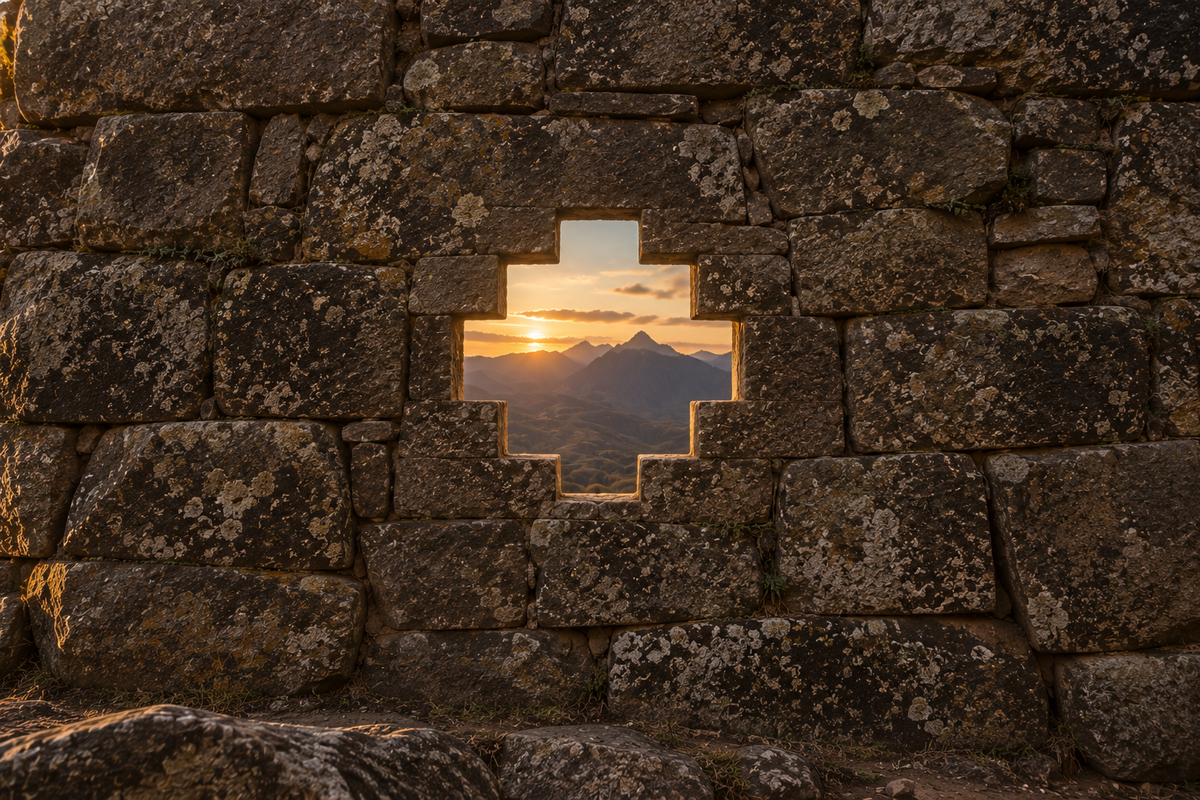
The Chakana - Map of the Living Cosmos
There is a shape that appears across the Andes with remarkable consistency - in stone carvings, in textiles, in pottery, in the crowns of deities. Four arms reaching toward the cardinal directions. Stepped edges at each arm. A circle at the center. And in the more developed forms, three levels corresponding to the three worlds.
This is the Chakana - and it is worth taking seriously as what it actually is: a cosmological diagram, not a decorative motif.
The etymology
In Quechua, chakana comes from chaka (bridge or crossing) and hanan (above). Literally: the bridge to above. But its meaning extends in all directions - not only upward. The Chakana maps the crossing points between all the realms: above and below, right and left, the manifest and the unmanifest.
At Chavín de Huántar, the Chakana appears on the crown of the Wanka - the great oracle monolith that has stood at the heart of the temple for over two and a half thousand years. Its placement at the crown of the most sacred object in the complex is not decorative. It is a statement: this is the geometry of cosmic order. This is the map by which the temple understands itself and its place in the living universe.
The agricultural calendar
The Chakana is also a calendar - one of the oldest ways the Andean peoples organised their relationship with time, the sun, and the land. Its four arms map the solstices and equinoxes, the four great turning points of the solar year. Each arm corresponds to a season, a moment of planting or harvest, a particular quality of light and energy.
In later Andean traditions, a more complex form of the Chakana developed - with twelve points rather than four, incorporating both solar and lunar cycles. This lunar Chakana adds an extra step to each arm, acknowledging the moon's own rhythm alongside the sun's. While the four-armed solar Chakana maps the year's great turning points, the twelve-pointed form integrates the monthly lunar cycle as well - a fuller cosmological map held in a single form. KANTU's Chakana pieces draw from the earlier, four-armed Chavín form, closest to the origin.
Dimensions of the cosmos
The Chakana encodes a cosmology in which the world above and the world below, the outer and the inner, are held in continuous relationship. These are not moral categories - not heaven, earth, and hell in any European sense. They are dimensions of reality, each essential, each interpenetrating the others.
In later Andean traditions - particularly the Inka and the living Q'ero lineage - this cosmology developed into a more formal three-part naming: Hanan Pacha (the upper world), Kay Pacha (the middle world), and Ukhu Pacha (the inner world). This framing is one of the great Andean cosmologies. But it is not Chavín's original language. In the older Chavín tradition, the world is held on two axes: above and below, outside and within. Beings move between them rather than belonging to one.
The center of the Chakana - the circle, the hole, the still point - is not empty. It is the axis: the place where the dimensions meet, the point of convergence from which all directions extend. To inhabit the center is to inhabit the intersection of all dimensions simultaneously. This is what the ancient teachers called Chawpin - the center of the center.
Duality within the form
The Chakana is not static. Its stepped arms encode movement - thresholds of transformation, each step a level of passage. And in the cosmovision of Chavín, the Chakana holds duality as its structural principle: the complementary forces that sustain each other, the dynamic tension between opposites that generates the living order of things.
This is why the Chakana appears in KANTU not as a symbol of stability or permanence, but as a symbol of dynamic balance - the harmony that is always in motion, always sustaining itself through the relationship of its parts.
Carrying the map
To wear the Chakana is not to adopt an identity or declare a membership. It is to carry a reminder: that you exist within an ordered cosmos, that you stand at a crossing point, that the four directions extend from wherever you are standing right now.
The center is not somewhere else. It is here.

Leave a comment
This site is protected by hCaptcha and the hCaptcha Privacy Policy and Terms of Service apply.