
Article: What is Chavín de Huántar?
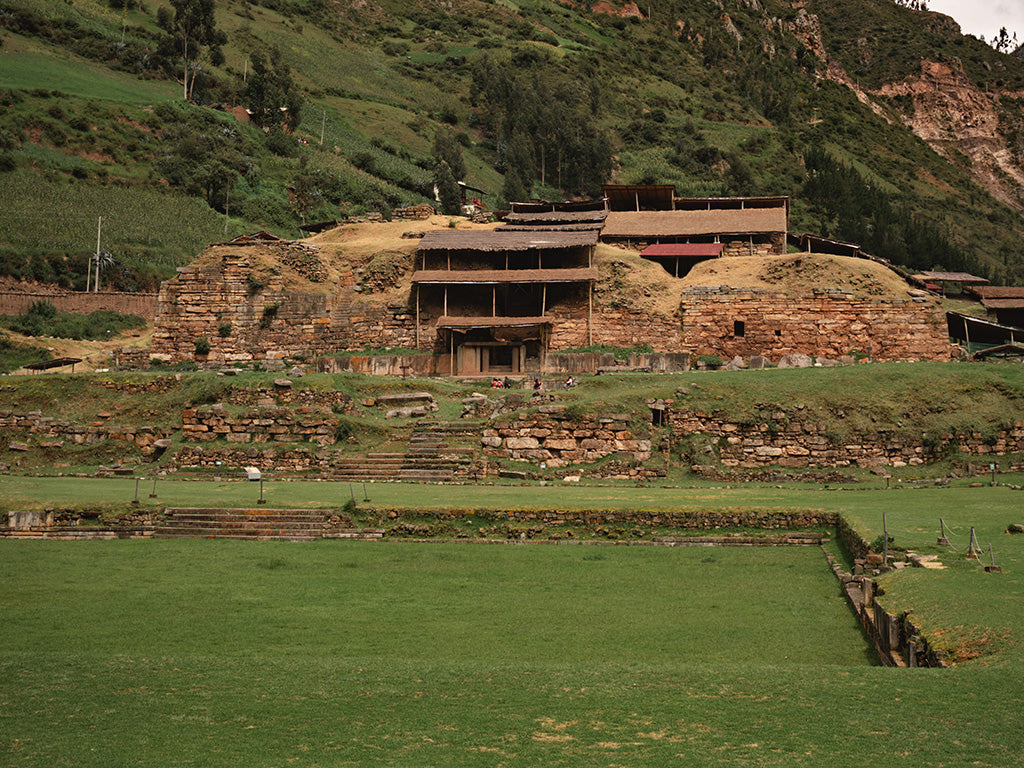
What is Chavín de Huántar?
Chavín de Huántar - The Center of the Center
Most people who encounter Andean history start with the Inca. The temples of Cusco, Machu Picchu, the great road system - these are what the imagination reaches for. But the Inca were, in many ways, inheritors. The cosmological roots that shaped Andean civilization run far deeper, and they lead, among other places, to a stone complex in the highlands of Áncash, Peru, built over three thousand years ago.
Its name is Chavín de Huántar. In Quechua, Chawpin - the center of the center.
Why here?
The site sits at an elevation of over 3,000 metres, where the Cordillera Blanca (the snow-tipped range, white because of the snow on its peaks) meets the Cordillera Negra (the range without snow). At their meeting, two rivers converge: the Wacheqsa, from Wacheqan, meaning 'it is giving birth,' born from the slopes of the snowy peak Watsan ('manifestation of the sacred'). And the Mosna, possibly from musiak, 'he who knows.' Where they meet, they form the Puchka, 'the one who spins.'
A river that gives birth meets a river of knowledge, forming a river that spins them together. Geography as cosmology, encoded in language.
To the Andean eye, this is not incidental. Water and mountain are presences, living forces, participants in the ceremonial reality of the place. The meeting of rivers represents the meeting of different worlds. The mountains are Jirkas - great beings, guardians, sources of power and wisdom. In the broader Andean world they are often called Apus; in the Quechua of the Áncash highlands, the word is Jirka, and it carries the same living presence: a mountain that is not a landscape but a being.
Chavín was built here because here is where things converge. That convergence is the meaning of its name: the center of the center. Not the center of a political territory, but the center of a cosmological map - the point where the visible and invisible worlds are closest to each other.
What was Chavín?
Scholars describe Chavín as a pilgrimage and ceremonial center - a place people traveled to from across a vast region, sometimes hundreds of kilometers, to receive teaching, to enter ceremony, to encounter the powers held there. The site contains a complex of stone galleries, underground passages, ventilation shafts, and open plazas that together created an environment of controlled sensory experience. Sound, darkness, water, stone: all were used as instruments of transformation.
At the heart of the complex stands the Lanzón - a four-meter carved granite monolith that remains in its original position in the inner sanctum, in the dark, to this day. It is one of the oldest sacred objects in the Americas still in the place it was made for. Those who know it call it Wanka Qun - the luminous divine force held in stone.
The visual language of Chavín
What makes Chavín extraordinary - and increasingly studied in archaeology, art history, and consciousness research - is its iconography. The stone carvings at Chavín are not decorative. They are a visual language of radical complexity, designed to encode cosmological knowledge in forms that could be perceived, studied, and transmitted across generations.
The figures are transformational. A feline becomes a serpent. A serpent becomes a raptor. A human figure carries the attributes of multiple animals simultaneously. Eyes multiply across bodies. Mouths open into other mouths. Nothing is fixed; everything is in process.
This is not artistic style - it is cosmological statement. The tradition of Chavín understands reality as fundamentally fluid, relational, and alive. The categories we use to separate things - animal from human, earth from sky, visible from invisible - are provisional. The stone carvings show what the world looks like when those categories dissolve.
A living tradition
What distinguishes Chavín from many ancient sites is that the tradition it represents has never fully disappeared. There are communities in the Áncash highlands who have maintained relationship with this cosmovision across the centuries - through changing political regimes, through colonization, through everything. The knowledge lives in families, in the land, in the ceremonies that continue to be practiced in the mountains surrounding the site.
This is what makes it possible to learn from Chavín today - not merely as archaeology, but as a living school. The symbols are not dead. The teachings have not been sealed in a museum. They are carried by people who walk with them, who practice them, who transmit them through direct relationship.
That is the tradition at the root of KANTU - not as historical reference, but as living lineage.

Leave a comment
This site is protected by hCaptcha and the hCaptcha Privacy Policy and Terms of Service apply.