
Patsamama - Not Only the Earth
The word arrives in global consciousness through the environmental movement, through indigenous rights campaigns, through a thousand wellness contexts where it becomes, gradually, synonymous with nature. And this is not entirely wrong. But something essential is lost in the translation - and what is lost matters deeply for how we understand ourselves and our place in the living world.
The etymology
Patsamama is a Quechua compound word. Mama is straightforward: mother, the nourishing source, the one who gives origin and sustenance. But Patsa - often rendered as Pacha in other Quechua dialects - means something that has no direct equivalent in any European language.
Patsa means space-time. Not space and time as separate categories. Not space as the physical world and time as its history. Space-time as a single, unified field - the fabric within which all things exist and all events unfold.
So Patsamama is not Mother Earth in the sense of the soil and the ecology, though she encompasses that. She is the Mother of space-time itself. The living ground of all existence - the field within which stars are born, within which mountains rise and rivers run, within which human lives unfold from birth to death and back again.
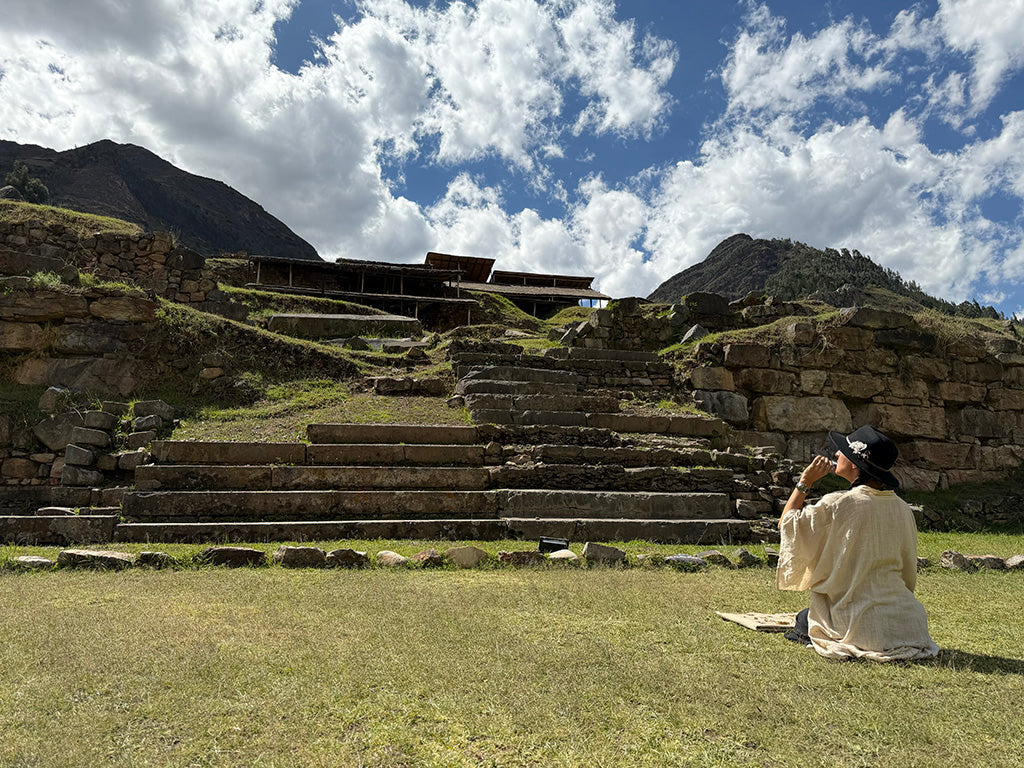
This is what my teacher means when she speaks of HATUN PATSAMAMA - the Great Patsamama - is a drop of water in which we each navigate as far as our sight allows. We are not visitors to her. We are drops within her. She does not surround us; she contains us.
What this changes
If Patsamama is only the earth, our relationship to her is environmental - about how we treat the soil and the water and the atmosphere. This is important and real. In the Andean understanding, it is also incomplete.
If Patsamama is space-time, then the relationship is cosmological. Every action taken anywhere in the field of existence touches her. Every thought is a movement within her. Every ceremony, every act of gratitude, every moment of genuine stillness is a form of communion with the living fabric that holds everything.
In the Andean tradition, this is not abstract philosophy. It is the basis of practice. When you offer to Patsamama, you are not only caring for the ecology of this particular place. You are entering into reciprocity with the field that holds you - acknowledging that you exist within something far larger than your individual life, and that this larger thing is alive, conscious, and responsive.
Patsamama and water
One of the most intimate ways the tradition relates to Patsamama is through water. As my teacher says: "que cada sorbo de agua sea el recordatorio de nutrir el cuerpo y, también al nutrir el cuerpo nutrimos el alma" - let each sip of water be the reminder that in nourishing the body, we also nourish the soul. Water in every drop is a source of infinite wisdom.
Water is the substance most directly expressive of Patsamama's nature - it fills the space available to it, it moves through time in cycles, it connects sky and earth through rain and river and sea. To drink water with awareness is to practice remembering who holds you.
On being a daughter or son of Patsamama
In the tradition of Chawpin, to say that someone is a daughter of Patsamama is not metaphor. It is a cosmological statement about origin and belonging. We all emerge from the same field. We all return to it. The boundaries we experience between self and world, between individual and cosmos, are real at one level of perception - and provisional at a deeper one.
This is what the tradition is always pointing toward: not the dissolution of the self, but the expansion of it. Not the loss of individuality, but the recognition that the individual is nested within something that is also alive.
You are not on Patsamama. You are within her. And she is within you.

Leave a comment
This site is protected by hCaptcha and the hCaptcha Privacy Policy and Terms of Service apply.