Skip to content

Cart

Your cart is empty

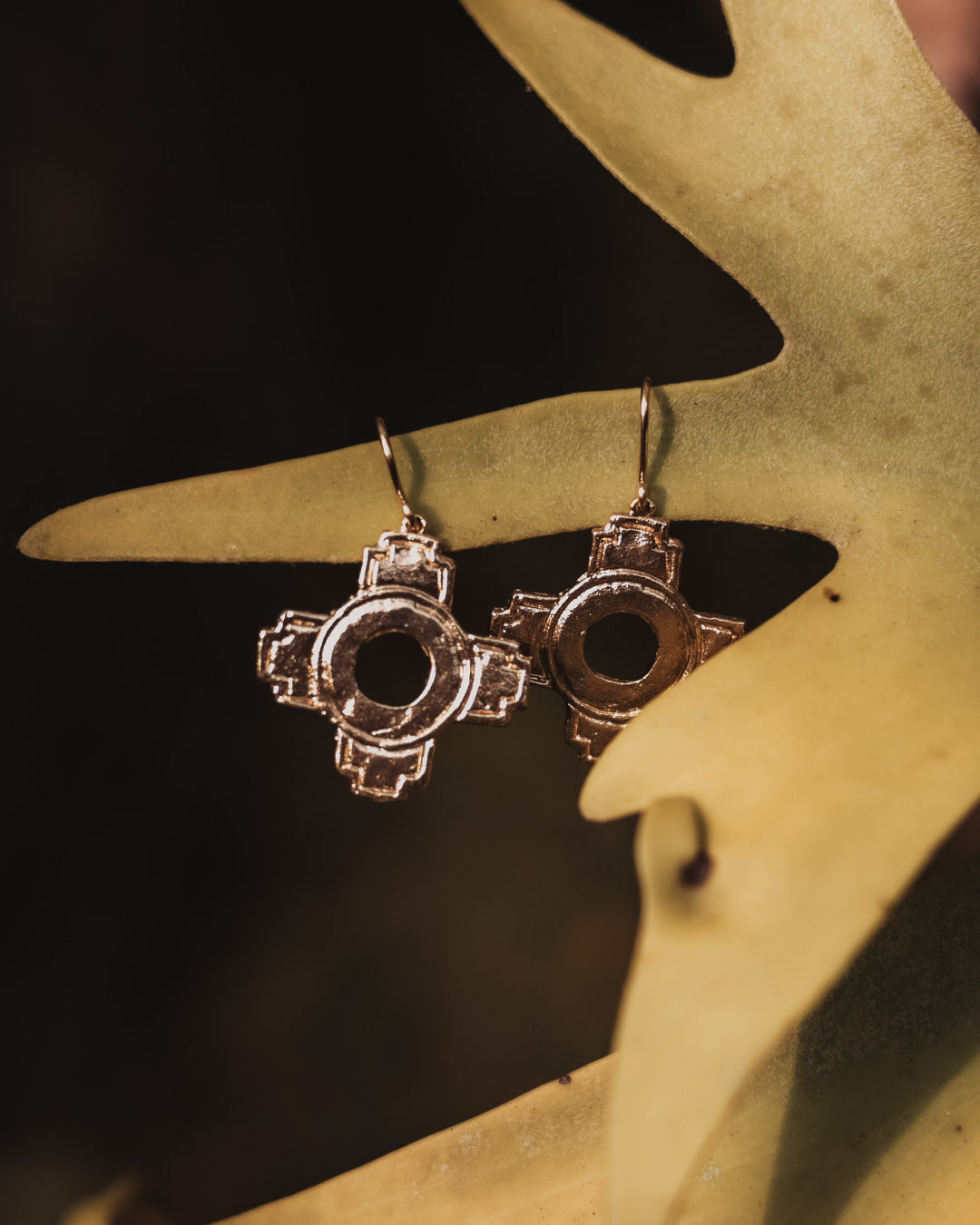
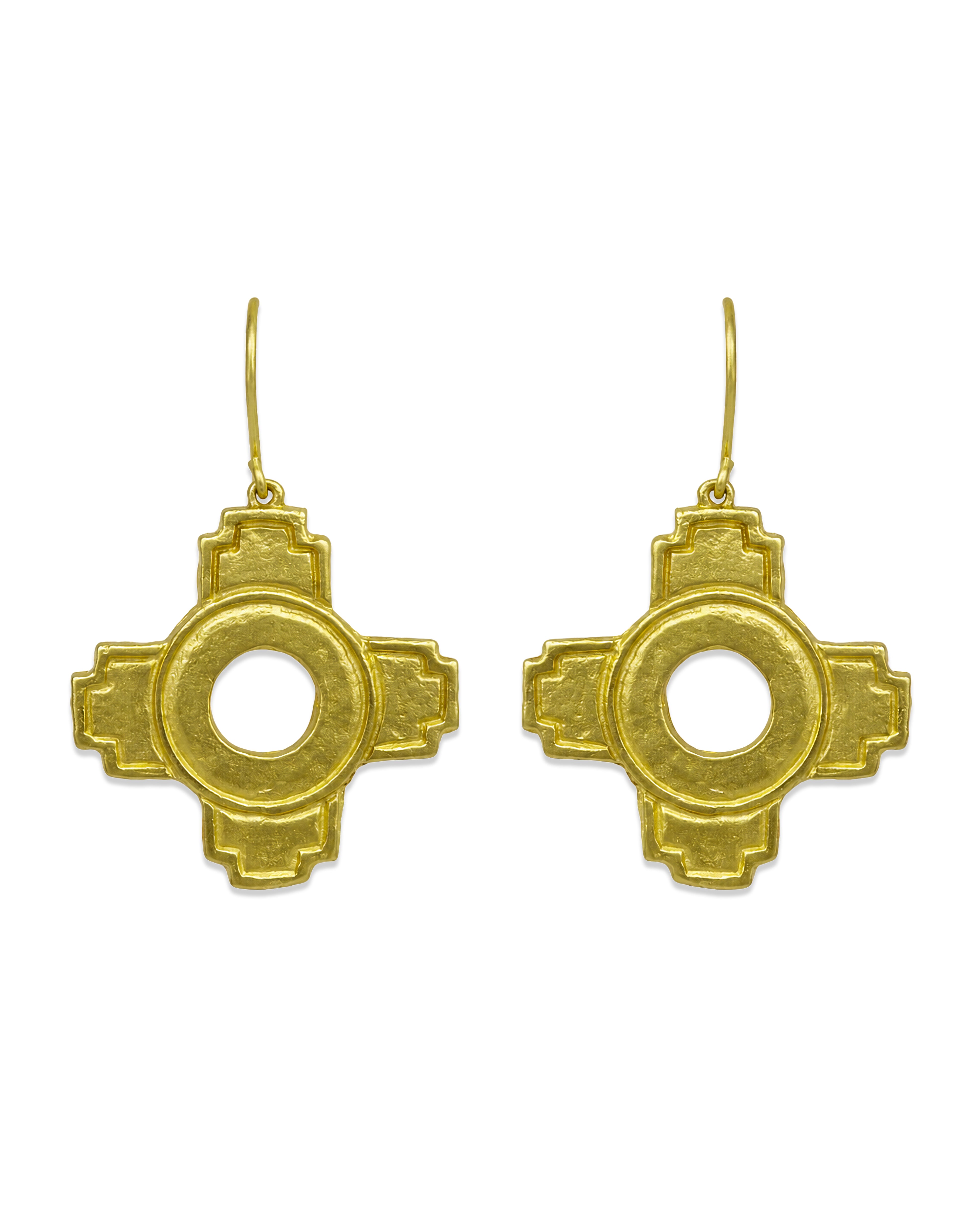
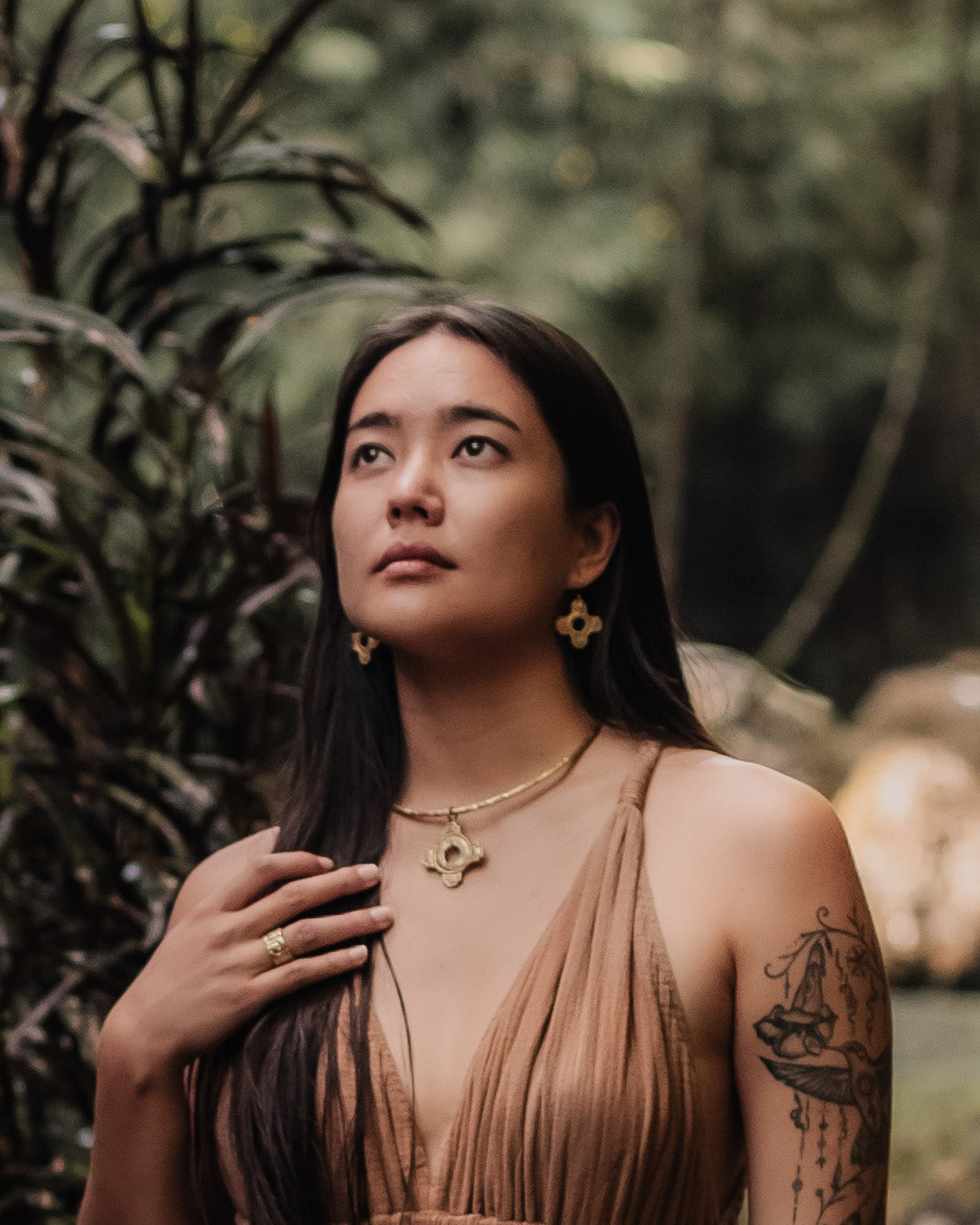
Tuku Ñawin Earrings

Sale priceRp 1.609.000,00

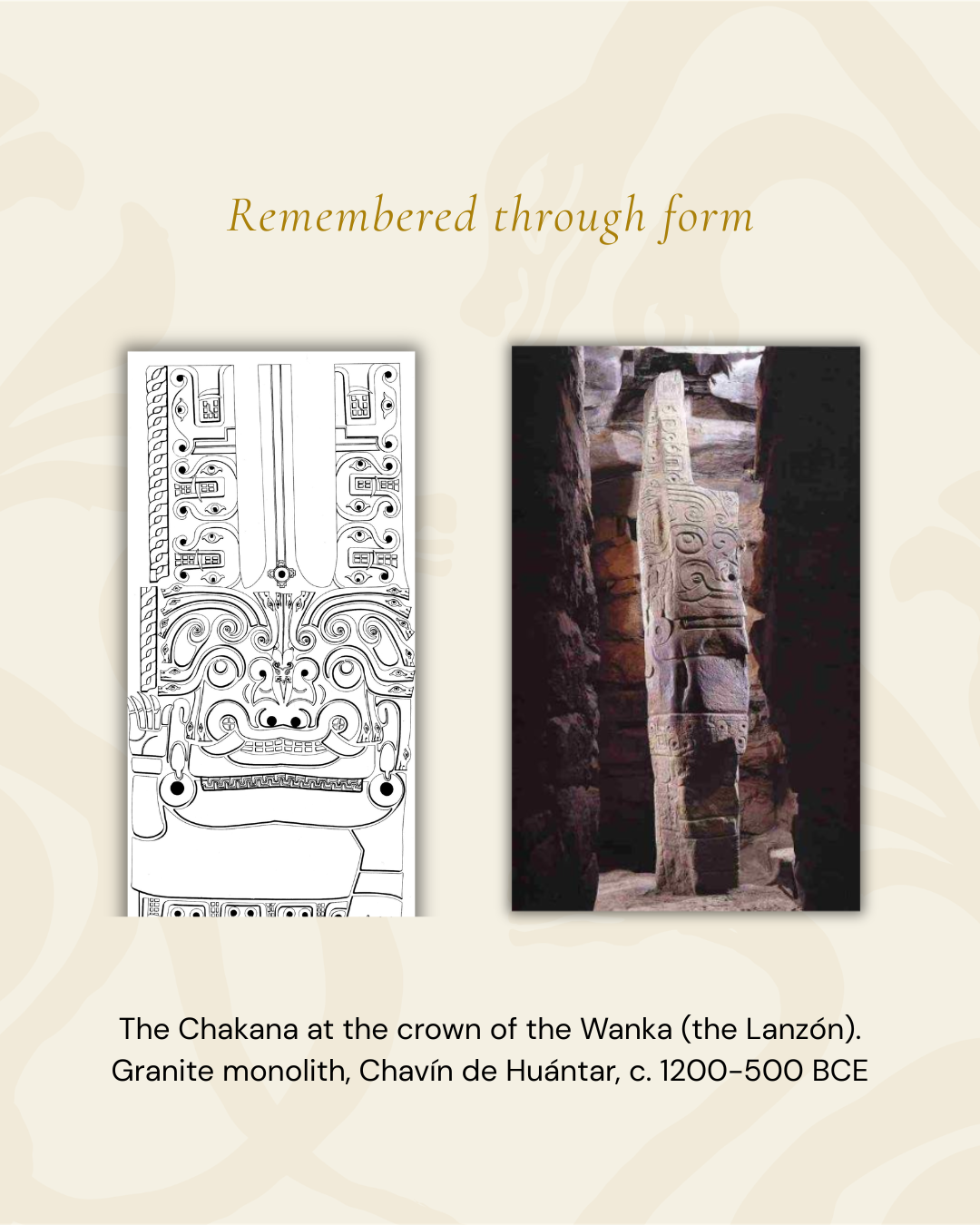
At the summit of the Wanka - the great sacred oracle monolith of Chavín de Huántar - rests a symbol so essential it needs no ornament: the primordial Chakana.

Not the twelve-pointed Inka cross that came later. This one is older, simpler, truer to the bone. A circle at the center. Four stepped arms reaching outward. Not decoration - cosmogram. Not geometry - map. The structure of life itself, carved into the crown of the oracle.

The center holds. The arms reach. The steps transform. The circle sees.

ABOUT YOUR PIECE

The Circle The open eye at the center. The source, the seed, the still point around which all turns. In Andean thought, the circle is not empty - it is full of potential, the space before form, the silence before sound. It is the axis around which the world organizes itself. To the owl (Tuku), this is the eye that sees in darkness, that holds stillness while everything else moves. The Four Arms Reaching north, south, east, and west - not as abstract directions but as living relationships. The arms connect: human to cosmos, inner to outer, the one who wears this to the four winds and all that moves between them. They are pathways, not boundaries. The Steps Each arm descends in thresholds. The Chavín understood life as a continual movement of ascent and descent - into the underworld and back to the heights, into silence and back to vision. The steps are not a staircase going up. They are a rhythm. A teaching that transformation is not linear, but a pulse. The Crown This Chakana sat at the very summit of the Wanka - the axis mundi of Chavín, the oracle still standing in its original chamber after 2,500 years. To place it there was to declare: this is the center of centers, the meeting point of all that is. The entire temple echoed this - built where the Mosna and Huachecsa rivers converge, raised from black limestone in the north and white granite in the south. Every stone carried the teaching: duality woven into wholeness.
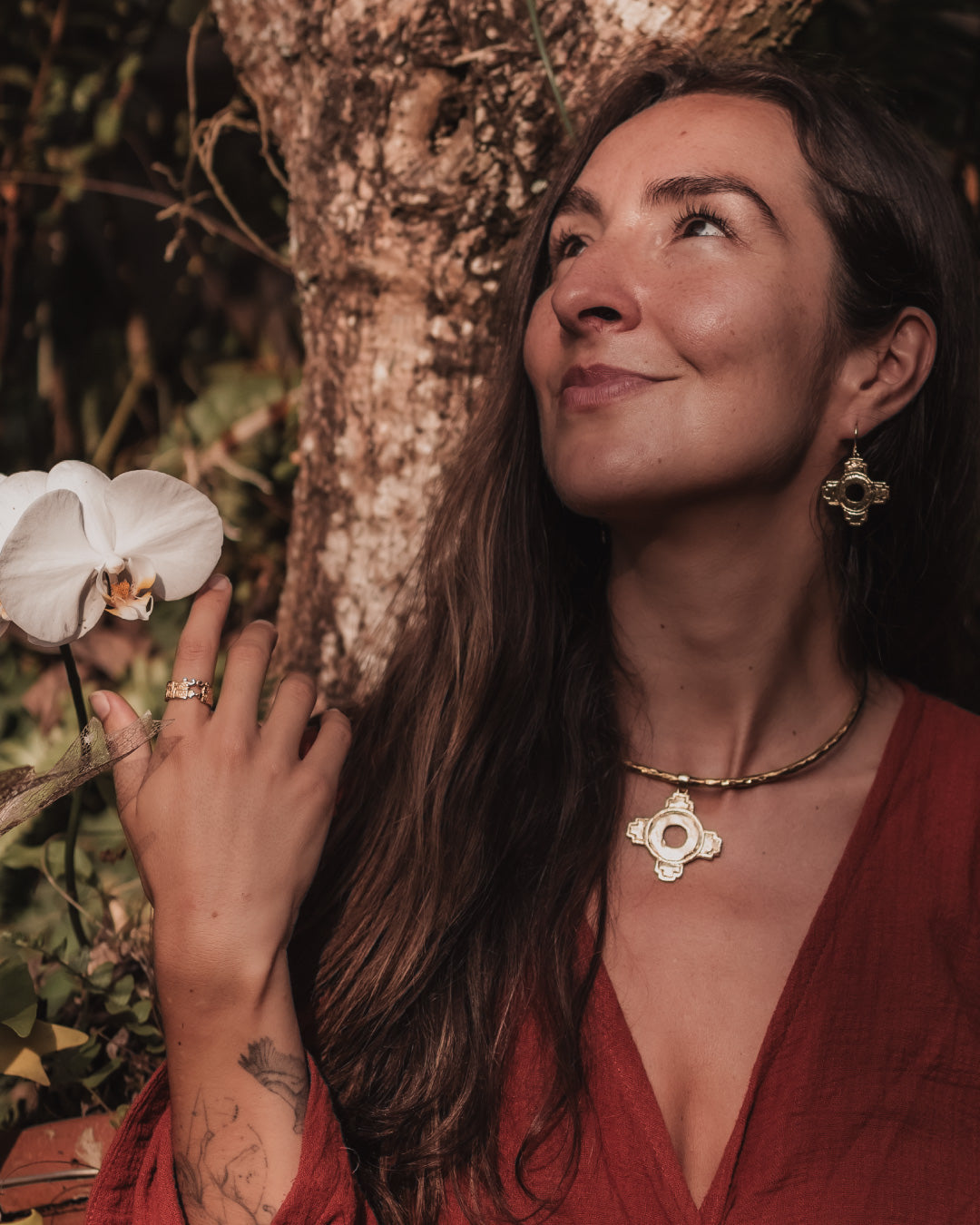
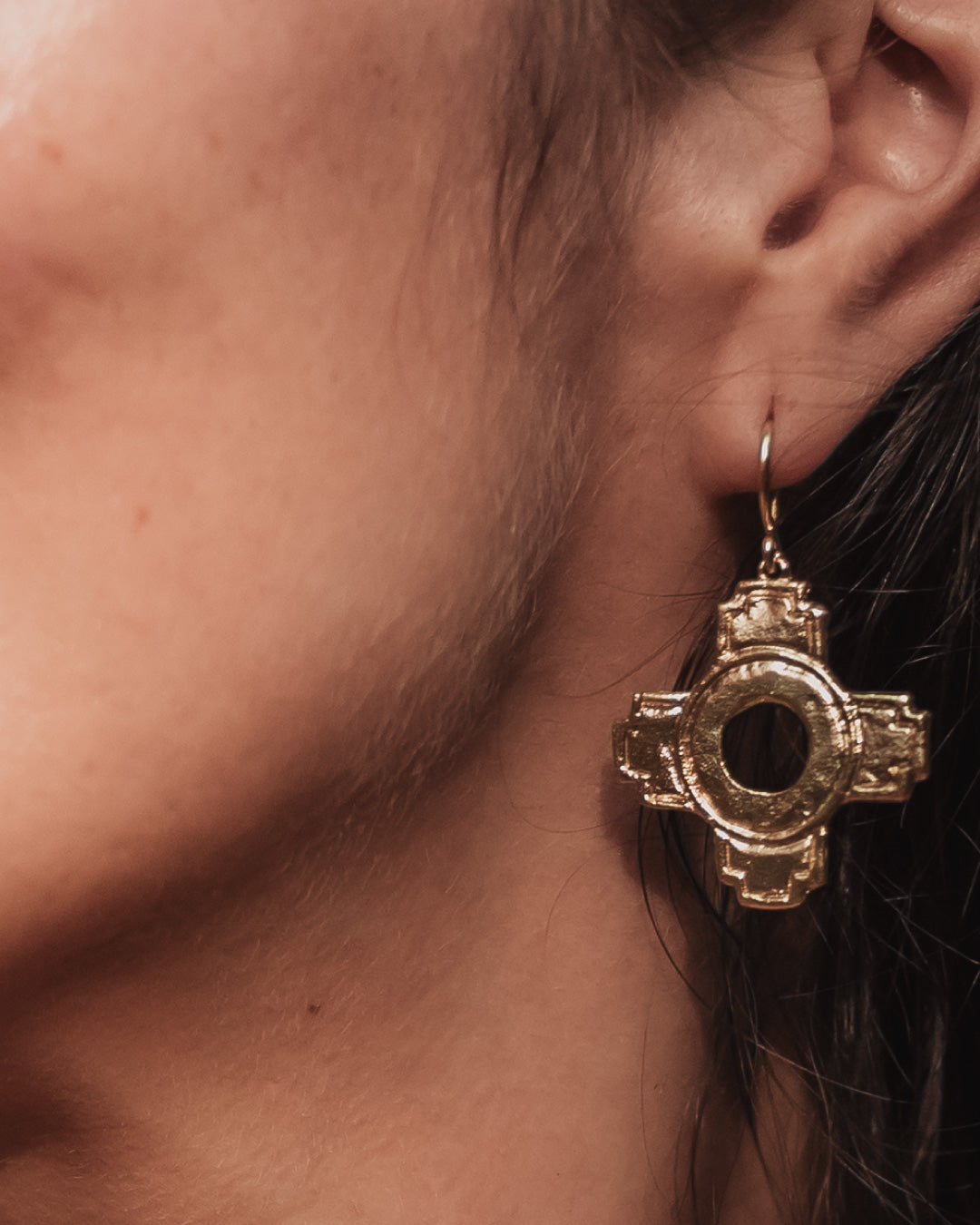
The Chakana at the ears becomes something specific: Tuku Ñawi - the Owl's Eye. The owl sees what others cannot. It holds perfect stillness at the center of its attention, and from that stillness, perceives everything. To wear this at the ears - the portals of perception - is to invite that quality of listening. Not just to sound. To the subtle communications of stone, water, wind, ancestor. To the voice that speaks not in words but in resonance. The Chavín knew that listening was sacred. The temple itself was a sound technology - built so that water rushing through underground channels created voices that moved through stone. Pilgrims who came to the oracle were not passive. They were tuned. They arrived to listen. To wear the Chakana here is to tune your own listening toward the center within. To become more porous to the dialogue of life. To remember that balance is not found - it is heard, again and again, in the space between breath and sound.
The Chakana carved at the summit of the Wanka (Lanzón) is one of the earliest known representations of this symbol in the Andes. The Wanka itself - a 4.5-meter granite monolith - has stood in its cruciform gallery at Chavín de Huántar for more than 2,500 years, making it one of the most significant sacred objects of the ancient Americas still in its original location. The symbol at its crown is distinct from the later Inka chacana (the twelve-pointed stepped cross). The Chavín version is more elemental: a circle at center, four stepped arms radiating outward in cardinal directions. This form appears across the Chavín iconographic system as a cosmological organizing principle - the structure through which the temple's dualities (black limestone/white granite, north/south, Mosna/Huachecsa rivers) are held in dynamic relationship rather than opposition. Scholars including Richard Burger (Chavín and the Origins of Andean Civilization, 1992) and John Rick (Stanford Chavín de Huántar Archaeological Project) have documented the Wanka as the axis mundi of the temple complex - the living oracle whose body encoded the full cosmology of Chavín. The Chakana at its summit was not incidental but architectural: the crown of the world-center, declaring the temple as the meeting point of realms. The form also appears in the temple's spatial organization itself. The cruciform gallery structure, the hydraulic systems that moved water under stone to produce ceremonial sound, the precise orientation of the Old and New temples - all echo the four-armed logic of the Chakana. It was not a symbol applied to the building; it was the building. Primary references: Burger 1992; Rick et al. (Stanford Chavín Project); Lumbreras 1977; Tello 1943; Rowe 1962 (on Chavín iconography); Kembel & Rick 2004 (on Chavín architecture and spatial organization).
Handcrafted in brass - chosen for its warmth, its quiet luminosity against the skin, and its long history of being worn close to the body. Brass is a living metal. It breathes with you, responding to your skin, your climate, the life you live. Over time it may deepen in tone or develop a soft golden patina. This is not wear. It is presence. - Material: Brass - Finish: Protective coating to slow oxidation - Made by hand in Bali, in collaboration with artisans who work metal from a place of respect for process and material - Designed in Peru Dreamed in Peru. Handcrafted in Bali.

PRACTICAL INFORMATION